Jill Choate Teaching a student how to weave a basket Photo Courtesy of Jill Choate
I came across Jill Choate Basketry when I was doing research on willows for my Idaho wildflowers book. I was curious to know how many basket weavers we have in Idaho. I found her while doing my research and her baskets are amazing! They are vibrant, colorful, and fun, and I knew I had to learn more about this basket weaver.
She makes her baskets from rattan reeds and dyes them herself. Many of her clients and customers have commented on the unique colors of her baskets. They are unlike anything else out on the market. She incorporates antlers and driftwood into many of her baskets which I find very cool!
Photos By Jill Choate
The story of how Jill got into basket weaving is interesting. When her family was living in Heron, MT they had a farm and did all of the logging and farming with draft horses. They used to do the local farmer’s market. At the farmer’s market one day she met a woman named Rane who turned her on to basket weaving. Rane was kind of a wild hippy chick who would do crazy things like float down the river, whack down some willows, and make a basket. She didn’t have a lot of technical basketry skills, but it caught Jill’s attention, and from then on she was hooked. She is a self-described renaissance woman, and basket weaving is an age-old craft that she wanted to learn.
From there she went to a class in Missoula, Montana and was taught by a woman named Bobbi Marshall Harris in antler basketry. Jill fell in love with antler basketry and began making her own designs. They left Montana and they soon moved to Alaska. They were dog mushers and had come to the south side of Denali, Alaska in the remote area of the Petersville area. They lived off the grid with 60 dogs at one time, but they did have an outhouse and sauna for some luxuries.
Photo Courtesy of Jill Choate
When they were living in Alaska, she was approached by a sales rep that wanted to sell her baskets. Her baskets ended up being sold all over the state of Alaska. Jill decided that she didn’t want to spend every moment of her waking life making baskets. It was at this point that she decided to teach basket weaving.
After that, she toured the lower 48 teaching from coast to coast with the entire family in tow. Her daughter Jennah was homeschooled, so, wherever Jill thought that Jennah needed to have an experience they booked classes. When Jennah went to college Jill had gotten tired of being on the road and teaching.
Years later she was doing a farmer’s market in Sandpoint, Idaho selling bike baskets for her daughter. This woman came up to her and said, “These are really cool baskets! My name is Rane.” and Jill said, “Well, yes it is. You are the woman that sent me down this path.” What a small world it is indeed.
Rane and Jill at The Farmer’s Market Photo Courtesy of Jill Choate
Jill Choate on Basket Weaving and Retreats
“There are a lot of different methods and techniques, and really one thing leads to another. I’ll get an idea of something (that) I’d like to create… I have to think about it to figure out if it’s actually possible to construct. If it’s a twill or design element, I have to get the paper and pencil out and graph it to see how it will work in the round.”
“I think that the intriguing thing about basketry is the math that’s involved in it. It’s sort of like solving a puzzle, and then you can take that puzzle and simplify it to teach it to others. That’s magic! So, basically I inspire people to push past their comfort zones at the retreats and try something daring. After 30 years, I don’t want to make your basket over and under baskets anymore.”
“People come to the retreat for different reasons. Some are dedicated basketmakers that are there to soak up every bit of information that I can offer. Others are there to enjoy the ambiance of the mountains, take a trail ride, hike, and maybe make a basket. Either way, it’s all good.”
“I have students that come from Alaska to Maine to attend the retreat, and it’s always a great time, with a great group. Women bring their husbands, and the husbands go fishing. I’ve got a couple of guys that attend regularly that weave.
“When you get to the Guest Ranch, it’s like you’ve just been incorporated into their family for a couple of days. Maybe a colt is being born, or something is up, and they just want to welcome you into the process. Dogs are in and out of the lodge. One of the reasons I decided to do it there was because of the accommodations and the food. Both are top notch.”
She made bike baskets at one point, but eventually gave that business to her daughter Jennah. Jennah’s business is called Cool Bike Basket and can be found on Facebook at https://www.facebook.com/coolbikebaskets/. There’s a very cool video showing Jennah making a bike basket with a friend.
Beyond that, Jill also makes brooms. Her latest endeavor is making mittens out of recycled sweaters that she gets from thrift stores. The mitten company is called Mad Mitt Co. and can be reached here https://www.facebook.com/madmittco/. She’s quite an amazing renaissance woman and an incredibly talented artist! For more information about the retreat, to purchase a basket, or to get a pattern for a basket please go to her website at https://www.jchoatebasketry.com/.
If you have been following the articles in this magazine, you already know that we support everything Idaho. Now, I have decided to create a new feature just for Idaho artisans and craftspersons.
Are you someone, or do you know of someone, who creates something beautiful and unique with their hands? Do they make pottery, jewelry, blow glass, or have a unique item that they create? We want to hear about it and see the pieces!
Submission guidlines are as follows: Please submit 3 or 4 photos of your best pieces, your name, email address, and a phone number to jaztnr@gmail.com and put CTAAC in the subject line so that I can weed out junk mail.
Featured artisans and craftspersons will be chosen based upon quality, aesthetics, and uniqueness. If your pieces get chosen we will get back to you and set up an interview and photo session.
Mike Garets Raptor Specialist with a Peregrine subspecies from South America. It’s a Peregrine Falcon named “Schmidt” Photo by Terry Welch
I have a tendency to run into articles purely by accident or by my own volition. I had wanted to do an article on The World Center Birds for Birds of Prey and The Peregrine Fund for purely selfish reasons. As most of you that have been following the magazine know, I am pretty diverse with my subject matter. When I was in elementary school we were told to write a paper on an animal of our choice. I chose to write a paper on the Osprey, which is a world wide raptor that is also found in Idaho. I wrote about how they are getting electrocuted by their wings touching on the hotwires of utility poles.
Later in life I went to work as a volunteer for Idaho Fish and Game and we were building boxes for the Osprey to nest in. These boxes were set up in marshes and on the edges of lakes. They are a pain in the butt to build, however, the end result is amazing! When you see a mating pair of Osprey and you know that you were responsible for setting up that nest it sends a chill down your spine and love in your heart, it’s an added bonus when they have babies in the nest!.
Terry and I met up with Raptor Specialist Mike Garets at The World Center for Birds of Prey and he was amazing with his knowledge! He has been the Raptor Specialist at World Center for Birds of Prey for 6 years. His degree is in biology, but as far as birds of prey go he is pretty much self-taught. He is also a falconer and owns a raptor that he uses for hunting. It’s a fascinating story.
The Peregrine Fund was started in 1970 by Doctor Tom Cade, who passed away about a month ago. He was a falconer, conservationist, and a scientist. He, and a number of other falconers and biologists, were alarmed at the decline of the Peregrine Falcon, the source being DDT. DDT is a pesticide that was touted as the wonder pesticide, but it had long-lasting effects, beyond what anyone could imagine. Rachel Carson took DDT to task and is very responsible for getting DDT banned in the United States. In her book, Silent Spring that was published in 1962, she spoke of the disastrous consequences of using DDT, and the decline of the Peregrine Falcon is just one example of what she was referring to.
The Peregrine Falcon was listed as endangered in 1999. Tom Cade started breeding Peregrines at Cornell University in New York using birds that were given to him by falconers. By 1974 they were able to release the birds into the wild in New Jersey. They successfully bred there and that started the recovery. They opened a western branch in 1974 in Fort Collins, Colorado. Their goal was to repopulate the Anatum Falcon, which is a sub-species of Peregrine. It had completely disappeared east of the Mississippi River. West of the Mississippi there were only 40 breeding pairs that they were aware of and only one breeding pair in California.
When they realized they were going to be successful, they opened a breeding facility in Fort Collins. That breeding facility was there until 1984. In the early 80s, The Peregrine Fund decided to consolidate the facilities that existed at Cornell and in Fort Collins. At that time, Morley Nelson, who was on the board of The Peregrine Fund stepped in. He was a long-time friend of The Peregrine Fund and Tom Cade going back many years. He convinced them that Boise was the best place for the peregrines and other birds to be preserved. Many entaties including Boise City and Idaho Power decided to jump in and help with it. They helped to procure the property where the World Center for Birds of Prey is situated in Boise. The rest of the property was donated by BLM (Bureau of Land Management). They relocated to Boise in 1984.
The Morely Nelson Snake River Birds of Prey National Conservation Area, located just outside of Melba, ID, has one of the highest concentrations of nesting raptors in North America, perhaps even the world. There is a lot to be proud of here in Idaho when it comes to raptors. There are 14 or 15 breeding pairs of Peregrine Falcons, as well as other raptors in this conservation area.
Guffey Bridge at Celebration Park ouside of Melba, Idaho
On any given year, depending on conditions, Peregrine Falcons may or may not breed in conservation areas. During the recovery of the Peregrine biologists tried cross-fostering where they have an adult Prarie Falcon raise the young Peregrine Falcon as if they were their own. However, they were never able to get the Peregrines to come back and nest in the Snake River National Conservation Area.
Right now they are breeding Caliofornia Condors at The Worl Center for Birds of Prey. They have around 60 Condors in their facility and they have 130 eggs that are viable. The Peregrine breeding stopped in 1999 but they started breeding Aplomado Falcons in the late 90’s. That continued until about 5 years ago. They still monitor populations in Texas, although they remain an endangered species.
Condors are still listed as critically endangered. There were approximately 22 Condors when conservationists took them out of the wild and put them into conservation captive breeding programs at the LA Zoo and San Diego Wildlife Park. In the 90’s some Condors were brought to Boise and they started breeding them in Idaho.
This may seem like the most unattractive bird to you, but in all reality they are amazing raptors. They clean up roadkill, dead animals, and they are incredibly smart. They have an amazing wing span of up to 10 feet! When you see a Condor in the air you know it. They are huge! Condors remain endangered because they are exposed to lead poisoning from spent ammunition. The lead exposure happens when the condors eat lead fragments found in carcasses and gut piles left in the field.
In Boise they have more Condors than any other facility in the U.S. They are also being bred at The Oregon Zoo. Some of the Condors that they breed in Boise get released into the Grand Canyon in Arizona, which is a big deal and is open to the public. The birds that hatch this year typically go into the wild at 18 months of age. They are very slow to mature, they stay with their parents for over a year. They fledge at 6 monthsof age, which means that they are developing wings that are large enough for flight.
Where they release the Condors is also home to wild Peregrine Falcons. West of the Mississippi there were only 39 known pairs in the United States when the Peregrine Fund started. The density now in the Grand Canyon is that they nest about every 3 miles. In Idaho they have documented between 55 and 60 nesting pairs of Peregrine Falcons. The nests are called eyries. There are undoubtedly more than 100 nesting sites or eyries in Idaho but Peregrines are very secretive. There are 200 nest sites documented in Montana along the Montana-Idaho border. Peregrines try to find a deep cavity where they are not exposed to weather conditions. To find them is very, very difficult. Researchers don’t have the manpower to go out and find every single eyrie so they don’t know how many nesting pairs we have in Idaho.
There are several eyries in the Treasure Valley. There is one in downtown Boise on the Century Link Building. There is eyrie that has been situated at The Sugar Beet Factory in Nampa for 25 years. There is a pair nesting on a tower that is located on private property in Meridian. So there are 3 pairs documented in the Treasure Valley, which if you think about it, that’s really not many.
There are probably some down in the Bruneau canyons. There’s four documented in Twin Falls and one in the Malad Gorge south of the I-84 bridge. They are around. The people from The Peregrine Fund see them all the time, but for a novice such as myself, you have to know what you are looking for. Most people that see one have no idea what they are looking at. The wings are very tapered with a wing span of 2.5 to 3.9 feet depending on the size of the bird. Females are typically 1/3 larger than the males. When they did a presentation at the shopping center on Garrity in Nampa, Mike said that on one of the towers there was a large female sitting on top. She probably nests at the Sugar Beet Factory.
The Aplomado (leaden in Spanish) Falcon, shown below, is no longer being bred at The World Center for Birds of Prey. They do, however, monitor their populations in the wild. There are about 38 pairs nesting along the Texas coast. When they are in the wild they are more white in their chest as opposed to the tawny color you see in the photo due to her being raised in captivity. It bleaches out after the first molt when they are in the wild. She’s a beautiful bird! While we were standing there watching her she danced up and down on her perch like a beautiful ballerina with wings.
Female Aplomado Falcon Photo by Terry Welch
The color pattern on “Schmidt”, a Peregrine Falcon, is very noticeable when you get up close with him. He has these very dark tapered wings and beautiful variegated colors on his back. On his wings he has a white stripe almost like a racing stripe on a car. His tail feathers are so pretty! This particular color phase is only found in Patagonia, Argentina. He is one of the birds that can tolerate cold weather like we had in Boise on the day we did the photoshoot. He is captive bred and very glove friendly, so friendly that even the volunteers at The World Center for Birds of Prey can handle him. Photo of Schmidt is shown below.
Mike Garets and Schmidt, a Cassini breed of Peregrine Falcon found in Patagonia Photo By Jaz Fagan
Terry took photographs of some of the other species of birds that they have at The World Center for Birds of Prey, such as the male Eurasian Eagle-Owl which looks mostly like an owl to me. When I first saw it I thought it was a Great-Horned Owl, but that just shows what I don’t know. Mike Garets informed me that they are cousins, closely related. We also got a great shot of the Harpy Eagle, which has a wing span of about 5 feet. They hunt sloths and monkeys and have very thick legs and talons. They have a greater grip force than any other raptor, about a thousand pounds per square inch. The photo below is a male that they bred, and at one time they bred them at The World Center for Birds of Prey, however, the program was moved to Panama in 1999 and captive breeding ended in 2007. The Harpy Eagle inhabits the tropical rainforests and is one of the most powerful raptors in the world. The Harpy Eagle photographed below was captive bred almost 17 years ago.
Peregrine Falcon
Eurasian Eagle-Owl
Harpy Eagle
Talons of the Harpy Eagle Photos By Terry Welch
We spent over an hour with Mike Garets and there was so much information. Too much to write about in one article, so please look for the next article which will discuss Falconry. In this article, I mainly tried to cover the conservation aspects and the different breeds of raptors that are housed at The World Center for Birds of Prey. Falconry and its history is a huge subject in and of itself so I made a command decision to write a separate article on that.
Thank you very much to Mike Garets, Tate Mason, and of course Schmidt for allowing us to take up your time and energy discussing all of the wonderful things about The World Center for Birds of Prey in Boise! You are all very amazing! Please go to their website for ticket prices and special events information at http://www.peregrinefund.org/visit
I went to the Taylor Guitars Road Show last night at Dorsey Music in Nampa and it was incredibly enlightening. I have to be honest here, as a rhythm guitar player, I never really think too much about many of the components that make up my guitars and their sound, I think many of us don’t. Last night, however, I learned quite a few things about guitars that I had never known or even contemplated before.
I had a chance to sit down with Eric Sakimoto currently the District Sales Manager at Taylor Guitars. He lives in Loveland, Colorado and travels all over doing these shows. He has been with Taylor Guitars for 12 years and at one time lived in El Cajon, California where Taylor Guitars is based out of. The funny thing was that he was originally from Caldwell, Idaho. What a small world!
Eric Sakimoto Photo By Jaz Fagan
The new models that they are promoting are the Grand Concert, which is their smallest full-size body shape. They are also introducing the Grand Pacific which has a new shape and a new sound. They are based on a dreadnought body with a slightly sloped shoulder on the upper bout and a little deeper in the upper bout as well. Both guitars have the V class bracing that they introduced last year on their Grand Auditorium body, which is their most popular body shape.
Photo By J.D.F
One of the unique structural advances in Taylor Guitars is the way the necks are attached. On other acoustic guitars the necks are glued onto the body and then the fretboard is glued on to the neck. Taylor Guitars developed the NT (New Technology) neck which is precision machined and bolted on. You can take the neck off by simply removing 3 bolts. There are 2 wooden shims that can be adjusted to push the neck backward and forward to easily adjust the action on your fretboard and strings. You can really dial in the exact height you want on your guitar strings.
Photo By Jaz Fagan
The coolest new innovation in Taylor Guitars is the V-Class Bracing. Ever since the creation of steel string guitars it has always been an X brace pattern. Since the X brace pattern covers the entire top of the guitars the guitar makers have used variations of the X brace pattern developed by Martin in the 1840s. Since the X brace pattern covers the entire top of the guitar, strengthening the top, but also dampening the sound, there’s always a compromise between volume and sustain. The goal for Taylor Guitars was to increase sustain and volume, to have the cake and eat it too so to speak.
V-Class Bracing
X Style Bracing
Andy Powers came to Taylor Guitars in 2012 and is a self-taught guitar builder. He built his first guitar when he was 7 years old if you can believe that, amazing! When he went to college he studied music so he’s also a professional musician. Andy’s not only amazing at building guitars, but he’s also an excellent guitar player, so he gets it from a player’s standpoint.
In 2014 he started redesigning Taylor Guitars, he took everything they knew about guitars and basically “threw the kitchen sink into these (new) models.” The V-Class Bracing opened up the wings of the lower bout to be far more flexible than with the old X bracing while still maintaining strength, which is how he was able to increase volume and sustain. Eric talked about the warble you may hear right after you tune your guitar, most noticeable when you go from a G chord to a D chord. The cause of that isn’t the guitar being out of tune, it’s the bracing in the guitar itself. The V-Class Bracing has the ability to sustain without hearing that warble.
The V-Class Bracing also improves the tuning of the guitar. Since the Taylor Guitars now have a different bracing the top moves differently. The X bracing can cause the guitar to sound out of phase, to get a warbling sound, or in some cases, certain chords don’t play in tune as well. With the V-Class Bracing, the soundboard actually rocks back and forth like a teeter-totter so when notes come off the top they come off at the same time. There’s more order to how the notes come off the top.
I’m going, to be frank here. I never paid much attention to certain parts of my guitar beyond the strings, nuts, frets, action, pickup, and the finish. I decided to put these diagrams in the article because they were times when Eric would be discussing certain parts of a guitar and I thought I knew what he was referring to, but in reality, I didn’t. I realized how little I truly knew about my instrument. I apologize to Eric if I seemed a little lost at times during our interview.
Eric grabbed one of the new models of Taylor Guitars and strummed a few notes for me. The sustain was amazing! Each note that he hit rang for days. It plays perfectly in tune, even 12 frets up, and the sound is nice and clean. He played the high B on the fretboard and it rang as loudly as the E note clear down on the lower part of the fretboard. It’s unreal to my ears how true the sound is and I never noticed before that my acoustic guitars warbled. Unfortunately, I don’t own a Taylor because they are like the Jaguar cars of guitars and I simply can’t afford one, much as I wish that I could.
Photo By Jaz Fagan
Here’s a video of Eric discussing all of the cool new facets of the brand new models from Taylor Guitars. Enjoy!
Photo By Jaz Fagan
Photos By Jaz Fagan
Luke Carter Playing A Taylor Guitar Photo By Jaz Fagan
The Taylor Guitars Road Show was so much fun and so enlightening, I also won a t-shirt! There’s no doubt whatsoever that they make some of the finest guitars that are not only beautiful to play but also an heirloom to be cherished and passed down. A huge thank you to Eric Sakimoto for taking the time to sit down and impart his extensive knowledge with me. It’s obvious that he is very passionate about the guitars and the work that he does. To find out more info on Taylor Guitars please go to their website athttps://www.taylorguitars.com/
When I was in the fifth grade I joined the orchestra and needed a violin. My mom took me to Dorsey Music and rented a 3/4 size violin for me. As I got older I outgrew my violin so we returned to Dorsey Music and she bought me a beautiful full-size Glazel. They are always great about helping students out with renting instruments purely in the best interest of keeping children eager to play music and making it affordable for parents to provide those instruments for their budding young musicians.
Dorsey Wheeler, the owner of Dorsey Music, was a former school band director. His stores in Nampa and Boise have been serving the Treasure Valley since 1969, with stores in Boise, Nampa, and now Ontario. Dorsey holds a degree in Music Education from Weber State University in Utah. By working with children he saw the need of students having access to musical instruments that were affordable, so he left behind his days as a music teacher and decided to open a store where he could sell instruments and rent to students. He has helped to put instruments into the hands of 1000’s of the future musicians of the Treasure Valley and still does.
Fender Acoustic Guitars Photo By Jaz Fagan
At one point or another, his children have worked at the store. His son Derek Wheeler told me that he had taken piano lessons when he was in school but quit after a month. Ironically enough he married a piano teacher who now teaches their children to play the piano. He has worked at Dorsey for over 20 years now and loves it. On some days he is setting up church PA systems, at others he is helping out at the store. There’s never a dull moment! The staff at Dorsey Music is always helpful and ready to answer any questions customers may have. They are comprised of musicians with extensive knowledge of the various instruments they play, and they are always willing to assist customers in finding the right instrument that fits into their budget.
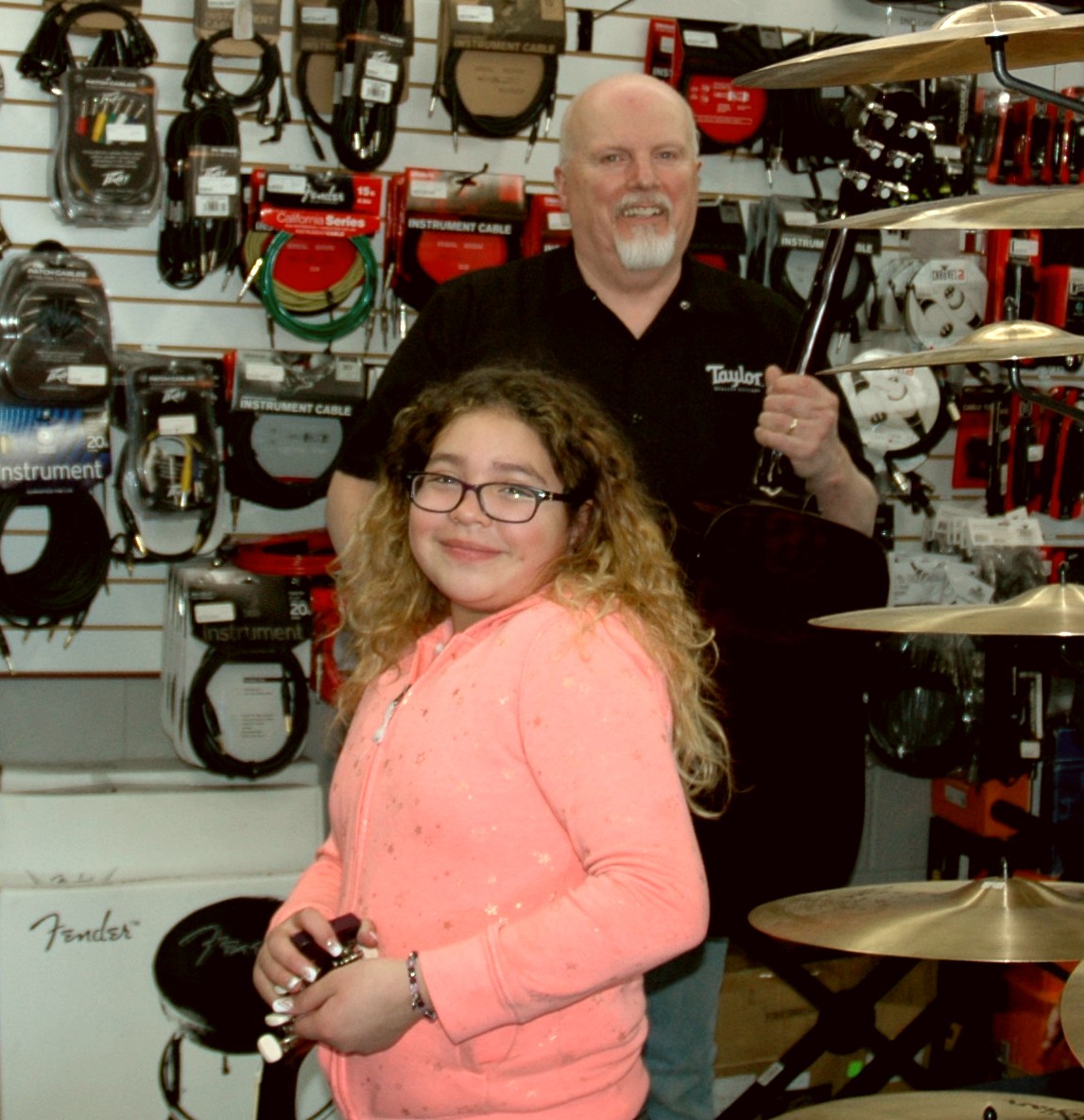
Dave Mundell helping a young girl get her first Fender Acoustic Guitar Photo By Jaz Fagan
Dorsey Music carries every instrument you can think of and some you probably can’t. From acoustic guitars to electric guitars, all kinds of orchestral stringed instruments, saxophones and trombones, drums and percussion instruments, as well as a Cajon or two. They also carry a wide array of PA equipment in a broad range of prices, both used and new, as well as accessories. I even saw a bad-ass cross that attaches to the top of a mic stand that I was tempted to buy.
Photos By Jaz Fagan
I met up with Dorsey last night at the Taylor Guitars Road Show and we talked about music, of course, and his new store that is having a grand opening in Ontario, Oregon this month. They are selling raffle tickets for $5 and all of the proceeds go to benefit the local music program of your choice. They have amazing prizes such as an Amati Violin worth $900, a Gretsch Hollow Body Electric Guitar worth $700, a Mio Flute valued at $1000, and so much more.
Dorsey is now in his 70’s and is still going strong! He commutes back and forth from the three stores and the love of his customers, music instruments, and music shows just in the way he affectionately discusses his business. Thanks to him and his wonderful store I was able to get my first violin and that little spark grew into what now is a professional musician. I can only say, “Thank you, Dorsey!” To find out more info about Dorsey Music please go to their website at https://www.dorseymusic.com/
Luke Carter Playing in The Taylor Guitar Room Photo By Jaz Fagan
When I was a little girl, I spent summers with my grandmother, bless her loving heart. She taught me so many things, like how to embroider, cook, paint ceramics, and to always love myself. One of the fondest memories I have was when she and I went to my hometown of Salmon, Idaho. We would be driving through the mountains, and she would see a wildflower that she wanted to add to her garden. She could spot a wildflower from a moving car as we drove in the mountains. It always amazed me!
So, off I would go, climbing a steep hill, to dig up a flower for her ever-expanding garden. I didn’t enjoy the climb at the moment, but it made her very happy. By all rights, my grandmother had one of the most beautiful gardens around. It was full of wildflowers, and she could tell you what every single flower was that was there. My grandmother, you see, was never ordinary, but extraordinary in all that she did.
Bittersweet Nightshade Photo by J.D.F.
A little over 2 years ago, I embarked on a journey to write a book about Idaho wildflowers. I spent over a year collecting the data for 227 different species and placing locations on an Idaho Atlas so that I could get in the field, collect specimens, and take photographs for the book. I didn’t get into the field until late last year because we had bought a new house and moved. I was also working 10 hour days for the county.
This year I am finally getting down to the actual writing. I’m hoping to have 100 species located, photographed, and entered into the book by the end of the season and have the first book published by December. It’s been an enlightening process. Each entry includes fun facts such as historical significance, edibility, medicinal purposes, and, of course, scientific data.
Some of the wildflowers that I was able to find last year are shown in this article. I enjoy writing, but the greatest part is getting out into nature with my camera and going on a treasure hunt. I get so excited when I find a species that I can’t wait to get home and download the photos to see what I got. I’m like a little kid at Christmas when I see a beautiful purple or yellow flower that I have been looking for.
Bull Thistle Photo By J.D.F.
I wish my grandmother were here to go with me on every treasure hunt. She would have loved it! I am so grateful to her for instilling in me the love of nature and wildflowers. I guess you could say that it’s largely due to her that I am a hippy. She was a woman with the biggest heart of anyone I have ever known. I miss her and love her very much. Thank you, grandma Marion!










 Idaho Gazette